

DOOM Eternal Tested on Low-end Graphics Cards
Earlier this week we benchmarked Doom Eternal extensively, but but using modernistic GPUs. Seeing that the game keeps receiving praises nosotros decided to get further and exam it on a more ample number of graphics cards. This time we take a petty over twoscore GPUs tested at 1080p using the low quality preset, with and without dynamic resolution scaling.
In a mode this works out to be a good guide for gamers who oasis't upgraded GPUs in several generations or every bit a second-paw GPU guide for Doom Eternal as we've tested a number of GeForce 600, 700, 900 and 10 series products, also as Radeon HD 7000, 200, 300 and 400 serial GPUs. For the sake of context we've also added some newer GeForce 1650 serial GPUs and Radeon RX 5500 results.

The idea here is to see what you tin get away with for smooth playable performance. Typically in that location's quite a large difference in performance betwixt a game'southward maximum and minimum quality presets, just coming from our previous examination we know that the game doesn't scale down that well for use with lower-end products. For instance, if y'all were to run Foreign Brigade using a GeForce GTX 1060 6GB or Radeon RX 580 at 1440p, both GPUs meet a ~65% increase in performance when going from Ultra to Depression.
But permit's say Strange Brigade isn't the best example because the game is not all that demanding to begin with. Using the same GPUs in Battleground V we run into around a ~110% performance increase when going from Ultra to Low. We cite these examples, considering when playing Doom Eternal right at present, there is only near a 20% performance increase when you lot get from the highest to the lowest graphics quality preset. In most other games, you can go a bigger performance bump simply past lowering shadow quality.

So while Doom Eternal plays very well on what's considered mainstream gaming hardware by today's standards -- the GTX 1060 or RX 580 -- it doesn't favor truly depression-end hardware, or merely older stuff that hasn't been optimized for this game at the commuter level. Our test consists of the same dynamic benchmark laissez passer we used to test current-gen hardware. This is a demanding benchmark and is representative of the performance you tin can wait to see in the more enervating areas of the game. And then while we're showing the GeForce GT 1030 averaging 23 fps at 1080p with resolution scaling disabled, in less demanding areas the frame rates will jump upwards merely over thirty fps.
But of course, you can't compare boilerplate frame rates across a controlled lx 2d criterion laissez passer, with peak frame rates in a given section. Gamers tend to exercise this often when spot checking their frame rates, only just because you're seeing ~40 fps in a less demanding area of the game, that doesn't mean the average will be 40 fps. We become that most of you understand this, only in games where you can easily monitor your frame rate, we get a lot of comments almost this.
Ane final example earlier nosotros show yous all the numbers: with the GTX 1060 3GB using the depression preset at 1080p we frequently saw frame rates well above 100 fps, hitting 150 fps at times. But as you lot're about to run across in the graph, the average was beneath 90 fps and this is because the scene nosotros use is demanding and the frame rates are fairly consequent with no large spikes.
Allow's now get into the results. As usual we're using our Core i9-9900K GPU test rig clocked at 5 GHz with 16GB of DDR4-3400 retention to remove whatsoever potential bottleneck.
Benchmarks
In full nosotros have 41 GPUs to look at, starting with results when resolution scaling is disabled. Falling below 30 fps and failing to deliver annihilation that resembles playable performance under these conditions is the GTX 760, GT 1030, GTX 750 Ti, GTX 660 Ti and quite shockingly, even the GTX 680. We believe the event here is a complete lack of optimization at the driver level.
Pushing over 30 fps we have the GTX 770 and GTX 780. The slowest tested Radeon GPU was the RX 550, averaging merely 39 fps. The game was playable at this frame rate, and we saw the GPU able to push button up around lx fps in less demanding areas.
The RX 550 matched the GTX 1050, another 2GB graphics bill of fare. And so we take the HD 7790, R7 260X, HD 7870, RX 460 2GB, R7 370 and GeForce GTX 960 all averaging between 40 - 46 fps and maintaining over xxx fps at all times.
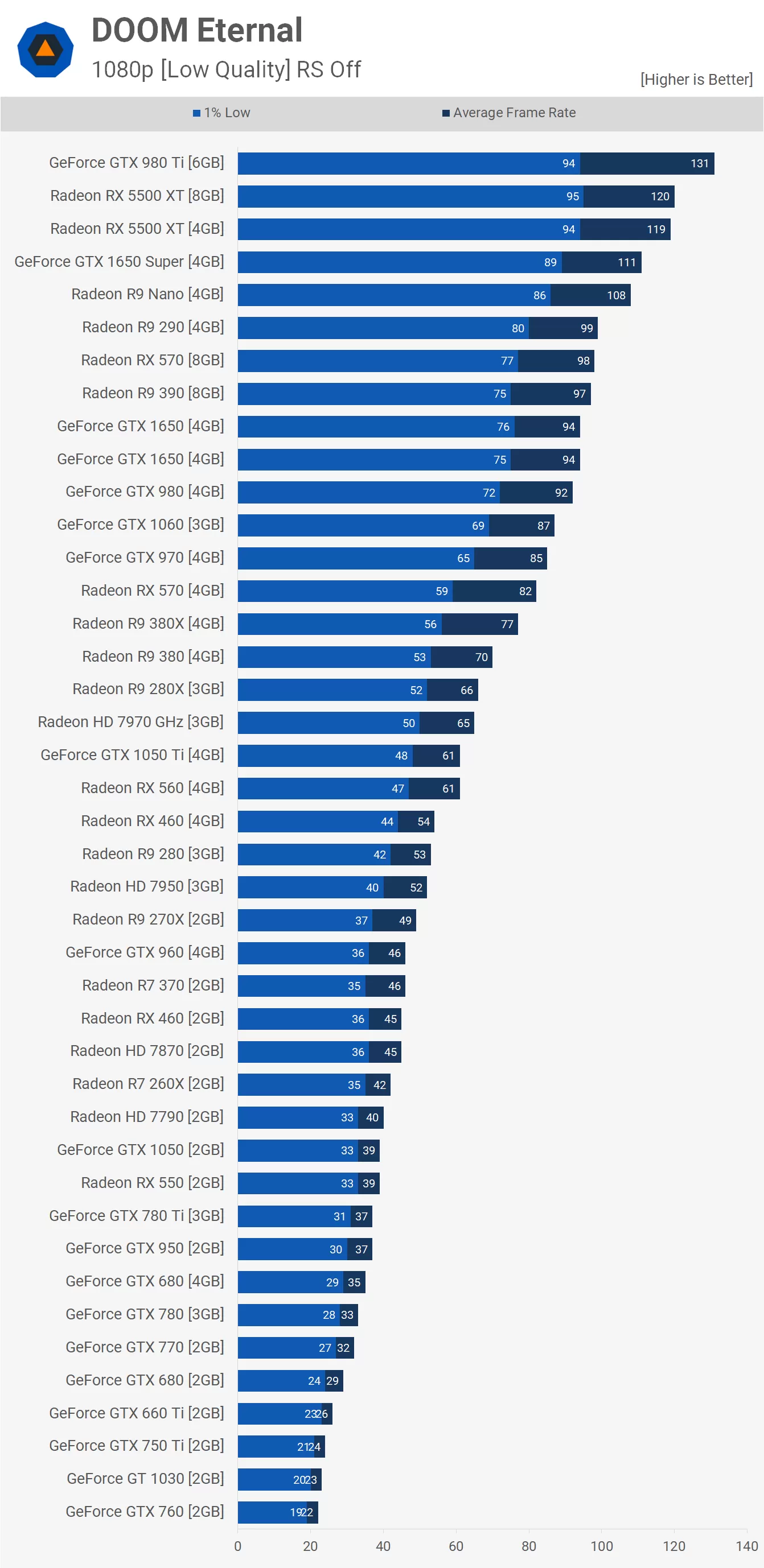
Gameplay started to become noticeably smoother with the Radeon Hard disk 7950, R9 280 and 4GB RX 460. Then nosotros see a large leap upwards in performance with the RX 570 and GTX 1050 Ti, both averaged 61 fps and now we're starting to see very polish performance.
When it comes to really old GPUs, AMD delivers the best results with relics like the HD 7970 never dipping below fifty fps in our exam. The R9 380 was extremely impressive with an average of seventy fps. To think this GPU in one case did battle with the GTX 960. The GeForce GPU managed just 46 fps making the R9 380 an incredible 52% faster.
Nosotros were surprised to observe the 4GB RX 570 simply delivering 17% more than frames than the R9 380, though the 8GB version was 40% faster. Interestingly, while we saw a 20% difference in performance betwixt the two GB and 4 GB version of the RX 460, we besides meet a 20% deviation between the 4 GB and viii GB version of the RX 570, which is a bit odd. Then again, that's what nosotros'd call Doom Eternal performance overall: a fleck bloody odd.
Above the 4GB RX 570 we find the GTX 970, GTX 1060 3GB, GTX 980 and then the GTX 1650. Beyond that we're looking at well over 100 fps on average, then information technology doesn't thing all that much.

Our 2nd fix of results have dynamic resolution scaling enabled with a target of 120 fps. For the most office this means the slower GPUs have been forced to a resolution target of -fifty%, and so the resolution scaling isn't dynamic simply rather forced.
Anyhow, with DRS enabled the GTX 760 however can't reach xxx fps on boilerplate. The GT 1030 now becomes somewhat playable, as does the GTX 750 Ti and GTX 660 Ti. The GTX 680 was able to keep frame rates above thirty fps throughout the elapsing of our test, for an average of 39 fps, which depending on your standards, is quite playable. We then see pocket-sized functioning improvements with the GTX 770, 4GB GTX 680 and GTX 780.
The GTX 780 Ti, GTX 950 and GTX 1050 scaled a little better with DRS enabled and with an boilerplate of over fifty fps, they were quite playable.
One time nosotros become to the Radeon GPUs nosotros're seeing a sixty fps average, so relatively smooth playable performance. The RX 550, Hd 7790, HD 7870, R7 260X and R7 370 all delivered basically the same level of operation and nosotros guess we tin as well include the GTX 960 and RX 460 here also.
For the next tier in performance you lot'll need a 4GB RX 460, HD 7970, R9 280X or GTX 1050 Ti and once we push beyond that we're starting to go into 100 fps plus territory. For high refresh rate gamers on a upkeep that don't mind enabling DRS, there are a number of relatively affordable GPUs to choice from.
What We Learned
That was a boatload of generally quondam GPUs put through their paces in Doom Eternal. Proceed in mind this data could change over the coming weeks and months if id Software continues to patch and optimize the game for better performance. The same is true for AMD and Nvidia drivers, though we wouldn't hold our breath on optimizations for products six years and older.

Based on the results shown, if you desire to run across over 60 fps at all times without enabling resolution scaling, your options are limited. From the older generations y'all'll require products such as the GTX 970 or R9 290/390 and from the newer generations an RX 570, 5500 XT or GTX 1650/1650 Super.
With resolution scaling enabled, which is essentially playing at 720p, yous can get away with products such as the RX 460 4GB or GTX 1050 Ti for over 60 fps at all times. For merely 60 fps on average there are more than options including parts such as the R7 260X and GTX 960.
The CPU used in your arrangement won't affair much with these GPUs equally yous'll nigh e'er be limited by the GPU, so expect similar results with fifty-fifty an old AMD FX processor -- and that's not something you'll often hear us say.

Every bit for the graphics presets, we hope id Software makes some changes here as it's obviously possible to brand the game look a lot worse than it currently does using the low quality preset and that would help out gamers with lower-end hardware. For now you can rely on the console to manually degrade some of the quality settings for better performance.
There are also a number of bugs that tank performance for no apparent reason. It had us messing around with the settings and sometimes resetting the game a few times before the original performance was restored. It's unclear to u.s.a. what'due south going on here, but appears to exist a adequately common problem as this operation bug has been widely reported online.
Finally, if y'all're looking for more than games to play on your old PC or laptop (even on integrated graphics), check out our guide 25 Slap-up Games You Tin Play on Laptops and Budget PCs.
Shopping Shortcuts:
- GeForce GTX 1660 Super on Amazon
- GeForce RTX 2060 on Amazon
- GeForce RTX 2070 Super on Amazon
- GeForce RTX 2080 Super on Amazon
- GeForce RTX 2080 Ti on Amazon
- Radeon RX 580 on Amazon
- Radeon RX 5600 XT on Amazon
- Radeon RX 5700 on Amazon
- Radeon RX 5700 XT on Amazon

Source: https://www.techspot.com/article/2001-doom-eternal-older-gpu-test/
Posted by: bowdenaningis.blogspot.com
0 Response to "DOOM Eternal Tested on Low-end Graphics Cards"
Post a Comment